Burnley single mum, and local entrepreneur Lorraine Tuley (Barber), who formerly set up successful a house-doctor business, has turned her hand to something quite different following health challenges – a project which has received Royal approval from TRH Prince of Wales and led to the start of a new creative and educational business venture.
Lorraine came across a small replica of the Coronation Chair in local charity shop, Emmaus, in 2011 and became fascinated by the story behind it. Her research revealed that it had been made by a Burnley man, Ronnie Lees, for the Coronation of Queen Elizabeth II in 1953.
Her journey thereafter, after delving further and further into the fascinating history of the real Coronation Chair and the Destiny Stone, led her to create her own replicas of the Coronation Chair which have now gone into production as a souvenir chair and are now on sale in the Westminster Abbey Shop in London and in her home town gift shop at Towneley Hall – but that’s just the start.
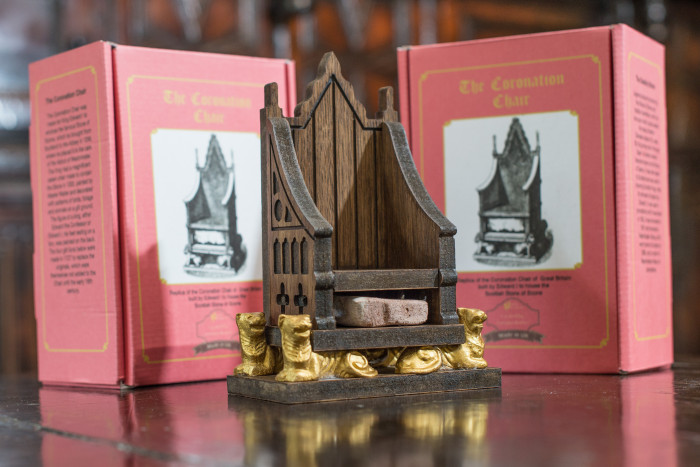
Lorraine Tuley said: “I have always had a passion for running my own business, and when I came across the old chair in the Charity shop it sparked an interest and idea that I could recreate the chair once again from here in Burnley.”
“I am working to develop a website to sell the chair in both finished and ‘build your own’ kit form in the UK and abroad to the souvenir market, particularly the American market that can’t seem to get enough of souvenirs relating to our English history and Monarchy.
“I am also very keen to work closely with the education sector to incorporate the chair into classroom learning. I have been working with local school, Unity College, where the students have loved making the chairs and learning about the history and story behind it and the role of the monarchy today – it is a wonderful creative way for children to learn about our history. The Westminster Education Department have also included the chair in their educational sessions.
“It’s been quite a long journey to get the necessary approvals to make the replica chair from Westminster Abbey and Buckingham Palace, but they had no objections and whole heartedly supported my plan, and I’ve just posted a chair to Prince Charles as a gift to thank him for his backing of the project.
“After meeting with buyers at Westminster Abbey and the Tower of London I am really excited about it going onto the shelves of these top London attraction souvenir shops. I am also in talks with Edinburgh Castle who are showing great interest in the chairs too. I’m also working on a full size version for display and order on request, so I’m keeping busy.”
Lorraine added: “I’d like to extend my thanks to Heritage Designs in Barrowford, who have helped me at each stage of my prototype to get to the right size for production. They have provided the CNC work to cut the pieces for the chair ready for assembly and been really supportive with project.”
Burnley MP Julie Cooper, who has visited the Westminster Abbey Educational Department and shop to see Lorraine’s Coronation Chairs said: “There is no shortage of talent in Burnley and I was delighted to recently meet Lorraine who has been inspired to begin producing replicas of the chair. I’m delighted her quality of work has been acknowledged by Prince Charles who has a great love of Burnley. I wish Lorraine every success with her new venture and will support her where possible with the promotion of her new venture.”
If local schools are interested in adding the chair to their classroom learning please email Lorraine at lorrainetuleyx@gmail.com
You can currently buy the chair at Towneley Hall gift shop in Burnley or online at http://shop.westminster-abbey.org/Replica-Coronation-Chair/dp/B012D46EC8
History of the Coronation Chair and the Stone of Scone
The Coronation Chair was made for King Edward I to enclose the famous Stone of Scone, which he brought from Scotland to the Abbey in 1296, where he placed it in the care of the Abbot of Westminster. The King had a magnificent oaken chair made to contain the Stone in 1300-l, painted by Master Walter and decorated with patterns of birds, foliage and animals on a gilt ground. The figure of a king, either Edward the Confessor or Edward I, his feet resting on a lion, was painted on the back. The four gilt lions below were made in 1727 to replace the originals, which were themselves not added to the Chair until the early 16th century. The Stone was originally totally enclosed under the seat but over the centuries the wooden decoration has been torn away from the front. At coronations the Chair with the Stone stands facing the High Altar. Every monarch has been crowned in this chair since Edward II in 1308, except Edward V and Edward VIII, who were not crowned. At the joint coronation of William III and Mary II in 1689 a special chair was made for Mary, which is now in the Abbey Museum. The Chair was taken out of the Abbey when Oliver Cromwell was installed upon it as Lord Protector in Westminster Hall. It was used by Queen Victoria at the 1887 Golden Jubilee Services in the Abbey. During the Second World War the Chair was evacuated to Gloucester Cathedral and the Stone was secretly buried in the Abbey. Most of the graffiti on the back part of the Chair is the result of Westminster schoolboys and visitors carving their names in the 18th and 19th centuries. The Chair was kept in the Chapel of St Edward the Confessor for many centuries until that chapel was closed to general visitors in 1997. In February 1998 the Chair was moved out to the ambulatory and raised on a modern pedestal near the tomb of Henry V. In April 2010 it was moved to a specially-built enclosure within St Georges Chapel at the west end of the Nave for essential conservation work.
A new plinth and canopy display for the Chair in this chapel was designed by the Abbey’s Surveyor Ptolemy Dean in 2013. During conservation and cleaning, under the supervision of the Hamilton Kerr Institute, a rare pigment called orpiment was discovered in the compartment which housed the Stone and tiny traces of vivid colour were found on the Chair. New wooden tracery was put in at the front of the Chair (the original had been missing since the 18th century). It was discovered that originally there was no seat and a cushion on top of the Stone was probably used in earlier times.
Stone of Scone
Legends abound concerning the Stone of Scone and tradition identifies it with the one upon which Jacob rested his head at Bethel – “And Jacob rose up early in the morning, and took the stone that he had put for his pillows, and set it up for a pillar, and poured oil upon the top of it” (Genesis chapter 28, verse 18). The legend then says that Jacob’s sons carried it to Egypt and from thence it passed to Spain with King Gathelus, son of Cecrops, the builder of Athens. About 700 BC it was said to be in Ireland, whither it was carried by the Spanish King’s son Simon Brech, on his invasion of the island. There it was placed upon the sacred Hill of Tara, and called “Lia-Fail”, the “fatal” stone, or “stone of destiny”, for when the Irish kings were seated on it at coronations the Stone groaned aloud if the claimant was of royal race but remained silent if he was a pretender. Fergus Mor MacEirc (died 50l?), the founder of the Scottish monarchy, and one of the Blood Royal of Ireland, received it in Scotland, and Kenneth MacAlpin (d.860) finally deposited it in the monastery of Scone in Perthshire (846). Setting aside the earlier myths it is certain that it had been for centuries an object of veneration to the Scots. Upon this Stone their kings, down to John Balliol in 1292, were crowned, and it is said that the following words were once engraved on the Stone by Kenneth:
The prophecy was fulfilled at the accession of James VI of Scotland and I of England in 1603. The Stone weighs 336 pounds and is composed of sandstone. It was stolen by Scottish Nationalists on 25 December 1950. After its recovery in April 1951 it was kept in the vault in which it had been stored during the Second World War and was not replaced in the Chair until February 1952, after elaborate precautions had been taken for its future safety.
However, on July 3rd 1996 the Prime Minister (John Major) announced that the Stone of Scone would be returned to Scotland by the end of the year, returning to the Abbey for coronations. On the evening of 13th November 1996 the Stone was removed from the Chair by representatives of Historic Scotland and put in a specially made crate. It was transported by stretcher to stand in the Lantern of the Abbey overnight and was removed in silence to the waiting police escort early on the morning of 14th November to make the long journey to Scotland by road. It can now be seen in Edinburgh Castle. So the Coronation Chair, once the oldest piece of furniture in England still used for the purpose for which it was originally built, now stands empty after 700 years.
For further information on the Stone contact Historic Scotland, 20 Brandon Street, Edinburgh, Scotland.